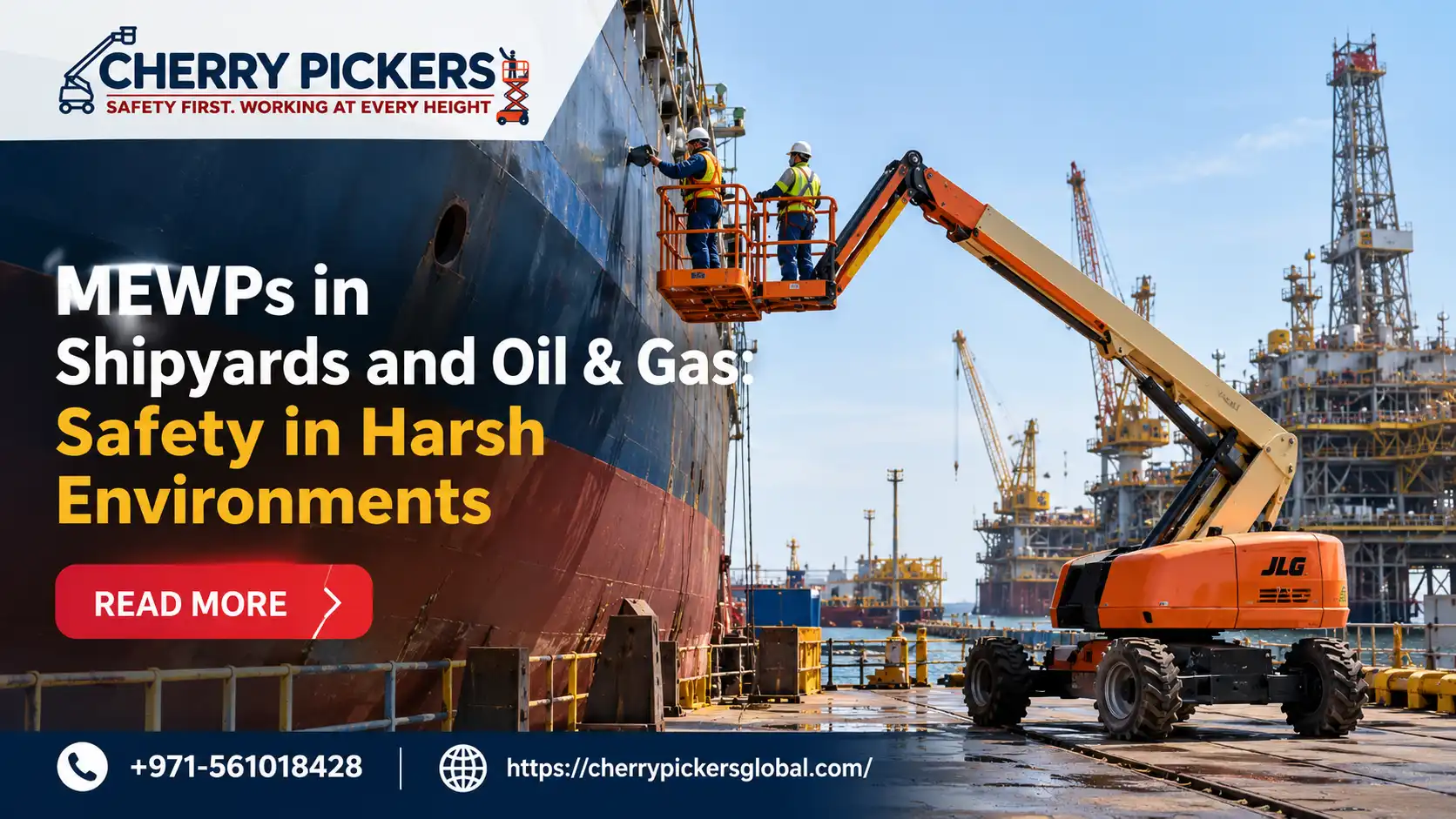
MEWPs in Shipyards and Oil & Gas: Safety in Harsh Environments
Shipyards and oil & gas facilities involve demanding working conditions where safety and reliable access equipment are essential. From ship maintenance and steel fabrication to pipeline inspections and industrial repairs, workers often need to perform tasks at height in challenging environments.
Mobile Elevating Work Platforms (MEWPs), such as boom lifts and scissor lifts, provide practical solutions for accessing elevated work areas. However, operating this equipment in shipyards and oil & gas facilities requires careful planning because of salt air, humidity, strong winds, restricted spaces and potentially hazardous areas. Choosing suitable access equipment is important for safe and efficient industrial operations.
Why Shipyards and Oil & Gas Facilities Require Specialised MEWPs
Shipyards and oil & gas facilities have different working conditions compared with ordinary construction sites. Equipment may be exposed to harsh weather, chemicals, moisture and challenging site layouts.
Some common challenges include:
- Salt air and moisture that can cause corrosion.
- Restricted access around ships, tanks and industrial structures.
- Potentially explosive atmospheres in designated hazardous areas.
- Uneven surfaces and difficult ground conditions.
- Heavy tools and materials used during maintenance work.
- Strong winds and changing weather conditions.
These factors must be considered when selecting a suitable MEWP for industrial applications.
Corrosion Resistance in Marine Environments
Shipyards and coastal facilities are regularly exposed to salt air and moisture. These conditions can cause corrosion and affect important parts of access equipment.
Corrosion may damage metal components, electrical connections, hydraulic fittings and other exposed parts.
When using boom lifts and scissor lifts in marine environments, businesses should consider:
- Protective coatings: Suitable coatings can help protect exposed metal surfaces from corrosion.
- Electrical components: Electrical connections should be inspected and maintained according to manufacturer recommendations.
- Hydraulic systems: Hoses, seals and fittings should be checked regularly for damage and leakage.
- Regular maintenance: Equipment may require more frequent inspections depending on environmental exposure.
- Proper cleaning: Removing salt deposits and moisture can help maintain equipment condition.
Regular inspection and preventive maintenance are important for keeping access equipment in good working condition.
MEWPs in Hazardous Areas: ATEX Requirements
Oil & gas facilities may contain areas where flammable gases, vapours or combustible dust create a risk of fire or explosion.
In these locations, standard access equipment may not be suitable. Electrical systems, motors and other machine components can potentially become ignition sources.
Before selecting a MEWP for a hazardous area, businesses should consider:
- Hazardous area classification: The site operator identifies and classifies areas according to the potential presence of explosive atmospheres.
- Equipment certification: Where required, equipment must have the appropriate certification for the specific hazardous area.
- Site approval: The equipment must meet the facility's safety requirements before entering or operating in restricted areas.
- Operating procedures: Operators must follow the site's safety instructions and permit-to-work requirements.
ATEX-certified equipment may be required in certain locations, depending on the hazardous area classification. Not every area within an oil & gas facility has the same requirements.
A standard boom lift or scissor lift should not be used in a classified hazardous area without confirmation of its suitability and approval from the relevant site authorities.
Access Equipment for Confined Spaces
Shipyards and oil & gas facilities often require maintenance work inside tanks, vessels, cargo holds and other restricted areas.
These locations can create challenges because of limited entry points, restricted movement and poor ventilation.
Before considering access equipment for these applications, the following factors should be assessed:
- Machine dimensions: The equipment must fit through available access openings.
- Working space: There must be sufficient clearance for safe positioning and movement.
- Weight restrictions: The floor and supporting structure must be able to handle the equipment load.
- Air quality: Atmospheric conditions must be assessed and monitored where required.
- Emergency planning: Suitable rescue and retrieval arrangements must be established before work begins.
Not every MEWP is suitable for confined-space operations. Equipment selection must consider the site layout, machine specifications and safety requirements.
Platform Capacity and Heavy-Duty Applications
Shipyard and oil & gas maintenance activities often require workers to carry tools, materials and equipment to elevated work areas.
Welding equipment, maintenance tools and installation materials can increase the total load on the platform.
When selecting a boom lift or scissor lift, consider:
- Maximum platform capacity.
- Number of permitted occupants.
- Combined weight of workers, tools and materials.
- Platform size and available working space.
- Manufacturer operating and loading restrictions.
Platform capacity must never be exceeded. For welding and other hot-work activities, additional fire prevention measures and site-specific safety procedures may also be required.
Key Safety Considerations for MEWP Operations
Safe MEWP operation in industrial environments requires proper equipment selection, trained operators and regular inspections.
Important safety considerations include:
Operator Training: Operators should have appropriate training for the MEWP category and machine they are using. Site-specific safety induction may also be required.
Ground Conditions: Before operating a MEWP, check the ground surface, slope, load-bearing capacity and surrounding obstacles. Uneven or unsuitable ground can affect machine stability.
Weather Conditions: Strong winds can affect the stability of elevated platforms. Operators must follow the manufacturer's maximum permitted wind speed and operating instructions.
Pre-Operational Inspection: Check the tyres, controls, guardrails, hydraulic systems, emergency lowering systems and other safety components before use.
Emergency Procedures: A rescue plan should be available before work begins. Operators and ground personnel should understand emergency lowering procedures and how to respond to equipment failure.
Following manufacturer instructions and site HSE procedures helps reduce risks during MEWP operations.
Choosing the Right MEWP for Industrial Applications
Selecting the right access equipment depends on the working height, horizontal outreach, ground conditions and type of work.
Different types of MEWPs are suitable for different applications.
Articulated Boom Lifts: Articulated boom lifts have multiple boom sections that allow the platform to move around obstacles. They are useful for maintenance, installation and inspection work where access is restricted by surrounding structures.
Telescopic Boom Lifts: Telescopic boom lifts provide extended horizontal outreach and are suitable for accessing elevated work areas over longer distances. They are commonly used for external maintenance and industrial applications where additional reach is required.
Scissor Lifts: Scissor lifts provide vertical access and a stable working platform on suitable surfaces. They are useful for installation, inspection and maintenance activities that require workers and tools to operate at height.
The final equipment selection should always be based on the project requirements, site conditions and manufacturer specifications.
Access Equipment for Your Industrial Project
Working at height in shipyards and oil & gas facilities requires suitable access equipment and careful safety planning. Factors such as corrosion, hazardous areas, confined spaces and ground conditions should be considered before selecting a machine.
At Cherry Pickers Equipment Rentals & Maintenance LLC, we provide boom lift and scissor lift rental solutions in Dubai and across the UAE for construction, industrial maintenance and other project requirements.
Whether you need an articulated boom lift, telescopic boom lift or scissor lift, our team can help you discuss your project requirements and identify suitable equipment options.
Contact us today to discuss your access equipment requirements.
Phone / WhatsApp: +971-561018428
Website: www.cherrypickersglobal.com
Frequently Asked Questions
1. Can standard MEWPs be used in oil & gas facilities?
Standard MEWPs may be suitable in non-hazardous areas, subject to site approval. Classified hazardous areas may require specially certified equipment.
2. Why is corrosion protection important for MEWPs in shipyards?
Salt air and moisture can cause corrosion and damage exposed machine components. Regular cleaning, inspection and maintenance help protect equipment condition.
3. Which type of MEWP is suitable for shipyard maintenance?
Articulated boom lifts, telescopic boom lifts and scissor lifts may be suitable for different applications. The choice depends on working height, outreach, access restrictions and ground conditions.
4. What safety checks are required before operating a MEWP?
Operators should inspect the machine, check ground conditions, review weather limitations, confirm equipment suitability and understand emergency procedures before operation.
5. Is special training required for MEWP operations in oil & gas facilities?
Operators need appropriate MEWP training. Additional site inductions, safety training and work permits may be required depending on the facility and job requirements.