Articulated Boom Lift vs Telescopic Boom Lift: How to Choose the Right One
When working at height, choosing the right boom lift can make a significant difference to the safety and efficiency of a project. Two commonly used types of boom lifts are articulated boom lifts and telescopic boom lifts.
Although both machines are designed to lift workers and tools to elevated areas, they work differently and are suitable for different site conditions.
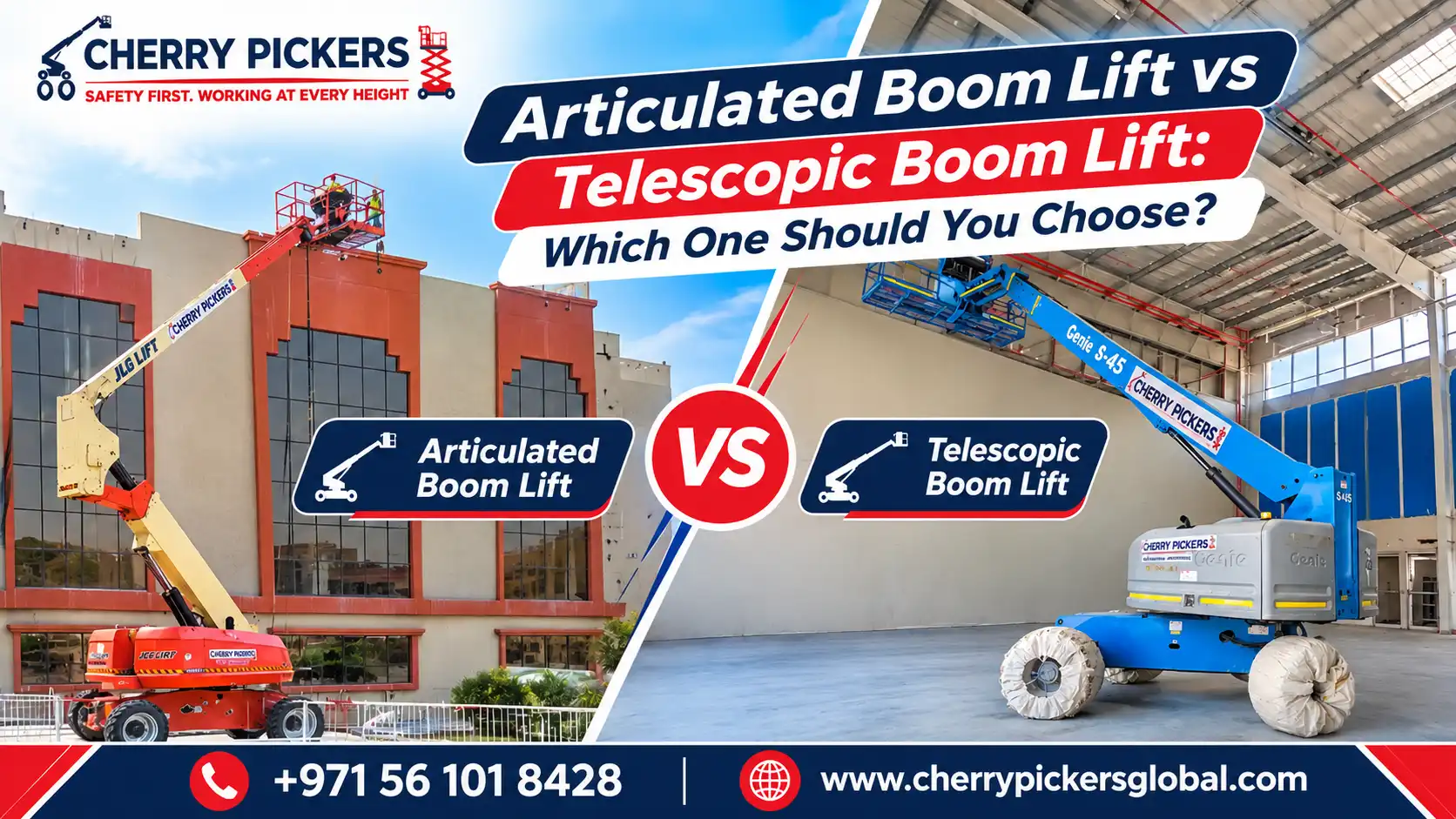
An articulated boom lift is useful when workers need to reach over or around obstacles. A telescopic boom lift is generally better when a job requires long, direct horizontal reach.
So, which one should you choose for your project?
Let's understand how these two machines differ and what you should consider before renting one.
1. What Is an Articulated Boom Lift?
An articulated boom lift, also known as a knuckle boom lift, has multiple boom sections connected by joints. These sections can bend and move in different directions, allowing the platform to reach areas that may be difficult to access with a straight boom.
Its main advantage is flexibility. Operators can position the platform over, under or around certain obstacles, depending on the machine's design and working limits.
Common applications include:
- Building maintenance and external repairs.
- Working around pipes, structures and other obstacles.
- Industrial facility maintenance.
- Electrical and lighting installation.
- Painting and maintenance in difficult-to-reach areas.
- Construction work where access is restricted.
Articulated boom lifts are available in electric and diesel versions. Electric models are often suitable for indoor or noise-sensitive environments, while diesel models are commonly used on outdoor sites.
2. What Is a Telescopic Boom Lift?
A telescopic boom lift, also called a straight boom lift, has boom sections that extend outward in a straight line. This design provides direct horizontal outreach and allows workers to reach elevated areas from a greater distance.
Unlike an articulated boom lift, it does not have multiple bending joints for moving around obstacles. Its main advantage is its ability to provide long, direct reach.
Common applications include:
- High-rise building construction.
- Steel structure installation.
- Large construction projects.
- Exterior building maintenance.
- Industrial facility work.
- Reaching elevated areas across open spaces.
Telescopic boom lifts are commonly available in diesel-powered models for outdoor applications. Electric versions are also available for certain applications and operating environments.
3. Articulated Boom Lift vs Telescopic Boom Lift: Key Differences
Both machines provide elevated access, but their designs make them suitable for different working conditions.
| Feature | Articulated Boom Lift | Telescopic Boom Lift |
| Boom design | Multiple sections with joints | Straight, extending boom sections |
| Movement | Can bend at joints | Extends in a straight line |
| Main advantage | Flexible positioning | Long, direct outreach |
| Obstacles | Can reach over or around obstacles | Best suited to clearer access paths |
| Working areas | Restricted or complex access areas | Open areas and large work sites |
| Common applications | Maintenance and installation | Construction and structural work |
| Available power types | Electric and diesel | Electric and diesel, depending on model |
The best choice depends on where the work needs to be performed, not simply on the machine's maximum working height.
4. When Should You Choose an Articulated Boom Lift?
An articulated boom lift is a suitable option when the work area contains obstacles or when workers need to approach a specific elevated position from an indirect angle.
For example, imagine a maintenance team working on lighting fixtures inside an industrial facility. Pipes, machinery and structural supports may block a direct route to the work area.
An articulated boom lift can help position the platform around these obstacles, provided the machine's reach and operating limits allow it.
Choose an articulated boom lift when:
- The work area has obstacles.
- You need to reach over or around structures.
- The access route is restricted.
- Maintenance work requires flexible platform positioning.
- The work involves different elevated positions within a limited area.
5. When Should You Choose a Telescopic Boom Lift?
A telescopic boom lift is generally a better option when the work requires long horizontal outreach and a relatively direct path to the elevated position.
For example, a construction team installing steel structures on a large outdoor site may need to reach elevated working areas from a distance. A telescopic boom lift can provide the direct outreach required, subject to its working envelope and site conditions.
Choose a telescopic boom lift when:
- You need longer horizontal outreach.
- The work area has a relatively clear access path.
- The project involves large outdoor spaces.
- Workers need to reach elevated structures from a distance.
- Construction or installation work requires direct access.
6. Factors to Consider Before Renting a Boom Lift
Before selecting an articulated or telescopic boom lift, evaluate the actual requirements of your project.
Working height
Check the maximum platform height and working height required for the job. Working height is commonly quoted as approximately two metres above platform height, but always confirm the manufacturer's specification.
Horizontal outreach
Horizontal outreach is the distance the platform can reach horizontally from the machine's centre or reference point, as defined by the manufacturer.
If the work area is difficult to approach directly, an articulated boom lift may be more suitable. If you need to reach a distant point in a relatively straight line, a telescopic boom lift may be the better choice.
Ground conditions
Check whether the machine will operate on concrete, asphalt, uneven ground or rough terrain. Select equipment designed for the site's surface conditions.
Working space
Consider the available space for positioning and operating the machine. Check the machine's overall dimensions, turning radius and access requirements.
Platform capacity
Consider the combined weight of workers, tools and materials. Never exceed the platform's rated capacity.
Power source
Choose the power type according to the working environment.
- Electric boom lifts: Often suitable for indoor applications, warehouses and areas where lower noise and zero exhaust emissions at the point of operation are important.
- Diesel boom lifts: Commonly used for outdoor construction and applications requiring equipment designed for rough-terrain conditions.
Always confirm the machine's suitability for the site and operating environment.
7. Articulated and Telescopic Boom Lift Applications in the UAE
Across the UAE, boom lifts are used in various industries, including construction, facility management, warehousing and industrial maintenance.
Some common applications include:
| Application | Suitable equipment to consider |
| Building maintenance around structures | Articulated boom lift |
| Warehouse lighting maintenance | Electric articulated boom lift, depending on access |
| Steel structure installation | Telescopic boom lift |
| Large outdoor construction sites | Telescopic or articulated boom lift, depending on reach |
| Industrial pipe and equipment maintenance | Articulated boom lift |
| Elevated work across open areas | Telescopic boom lift |
These are general guidelines. The final selection should be based on the required working position, machine specifications and site assessment.
8. Common Mistakes to Avoid When Choosing a Boom Lift
Selecting equipment based only on maximum working height can lead to problems during a project.
Avoid these common mistakes:
- Ignoring horizontal outreach: A machine may reach the required height but may not reach the actual working position.
- Not checking obstacles: Buildings, pipes and other structures can affect machine positioning.
- Choosing the wrong terrain type: Not every boom lift is suitable for uneven or rough ground.
- Overlooking platform capacity: Workers, tools and materials must remain within the rated load limit.
- Ignoring access dimensions: Check whether the machine can enter through gates, doors and narrow access routes.
- Selecting equipment without understanding the application: Consider the complete working area before deciding between articulated and telescopic models.
A proper site assessment helps reduce equipment selection problems and avoid unnecessary rental costs.
Choose the Right Boom Lift for Your Project
Choosing between an articulated and telescopic boom lift depends on the working height, horizontal outreach, site conditions and access requirements.
An articulated boom lift offers greater flexibility when working around obstacles, while a telescopic boom lift is generally suitable for applications requiring direct horizontal reach.
At Cherry Pickers Equipment Rentals & Maintenance LLC, we provide access equipment rental solutions for construction, industrial, warehouse and building maintenance applications across the UAE.
Contact our team to discuss your project requirements and find a suitable boom lift.
Contact: +971 56 101 8428
Email: office@cherrypickers-rentals.com
Website: www.cherrypickersglobal.com