
Why Foam-Filled Tyres Are the Best Choice for Telescopic and Articulating Boom Lifts?
Boom lifts are widely used in construction, industrial facilities, building maintenance and other projects that require working at height. They help workers reach difficult areas safely and carry the tools needed for their jobs.
When choosing a boom lift, people usually consider working height, lifting capacity and horizontal reach. However, tyres are also important because they affect how the machine moves and performs on different surfaces.
Many telescopic and articulating boom lifts use foam-filled tyres. These tyres are especially useful on construction sites where nails, sharp metal pieces, stones and other materials can damage normal tyres.
But what are foam-filled tyres, and why are they commonly used on boom lifts? Let's understand their benefits and how they differ from regular tyres.
1. What Are Foam-Filled Tyres?
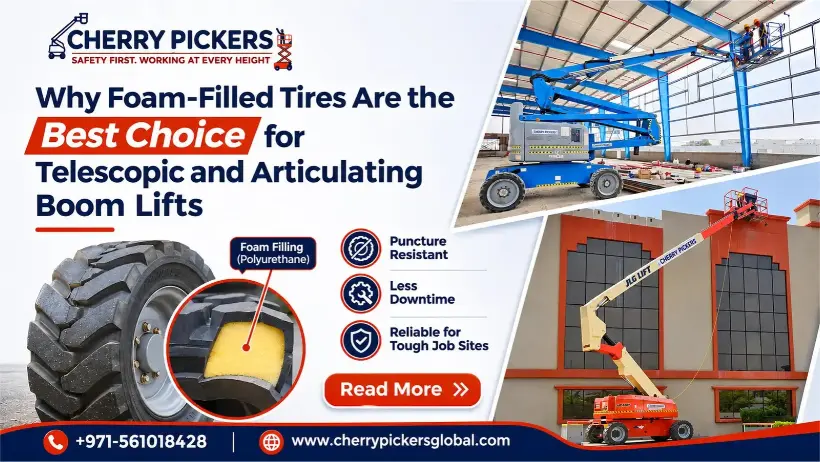
Foam-filled tyres are regular industrial tyres filled with special polyurethane foam instead of air.
Normal tyres use compressed air to maintain their shape. Foam-filled tyres use the foam inside to support the tyre.
This means they do not lose air when an ordinary puncture occurs. As a result, they are useful for machines working in areas where sharp objects and construction waste are common.
Foam-filled tyres are used on different types of construction equipment, including selected telescopic and articulating boom lifts.
2. Why Do Boom Lifts Use Foam-Filled Tyres?
Boom lifts often work in challenging environments such as construction sites, factories and industrial yards.
These areas may have nails, metal pieces, broken concrete and sharp stones on the ground. Such objects can easily damage normal air-filled tyres.
When an air-filled tyre gets punctured, it may lose air and require immediate repair or replacement. This can stop the machine from working and delay the project.
Foam-filled tyres help reduce this problem because they do not depend on air pressure. Even if the outer tyre gets an ordinary puncture, the foam inside continues to support its structure.
This is one of the main reasons they are commonly used on boom lifts.
3. Key Benefits of Foam-Filled Tyres for Boom Lifts
A. Better Puncture Resistance
One of the biggest advantages of foam-filled tyres is their resistance to puncture-related air loss.
Construction sites often have sharp objects that can damage normal tyres. Foam-filled tyres reduce this risk because they contain polyurethane foam instead of compressed air.
This makes them a practical option for boom lifts working on construction and industrial sites.
B. Less Equipment Downtime
A damaged tyre can interrupt work and delay project activities.
With normal tyres, operators may need to stop the machine and arrange repairs before continuing.
Foam-filled tyres help reduce interruptions caused by ordinary punctures. This can help contractors keep their projects moving and reduce unexpected maintenance work.
C. Consistent Tyre Support
Tyres help support the boom lift and maintain contact with the ground.
Foam-filled tyres maintain their shape without depending on air pressure. This helps provide consistent support during machine movement.
However, a boom lift's overall stability also depends on ground conditions, machine condition, load limits, and correct operation.
D. No Regular Air-Pressure Checks
Normal tyres need regular air-pressure checks to make sure they have the correct pressure.
Foam-filled tyres do not require routine air-pressure adjustments after proper filling.
This makes one part of equipment maintenance easier.
However, operators must still inspect the tyres for cuts, cracks and other damage.
E. Suitable for Tough Working Conditions
Construction and industrial sites do not always have smooth surfaces. Boom lifts may need to travel across concrete, gravel and other approved working surfaces.
Foam-filled tyres are useful in these environments because they reduce the risk of sudden air loss caused by ordinary punctures.
They are a practical choice for many construction, installation and industrial maintenance applications.
4. Foam-Filled Tyres vs. Air-Filled Tyres
Both tyre types are used on industrial equipment, but they have different features.
| Feature | Foam-Filled Tyres | Air-Filled Tyres |
|---|---|---|
| Filling | Polyurethane foam | Compressed air |
| Puncture resistance | High | More vulnerable |
| Air-pressure checks | Not required | Required |
| Ride comfort | Generally firmer | More cushioning |
| Weight | Generally heavier | Generally lighter |
| Maintenance | Visual inspection | Pressure and visual checks |
Foam-filled tyres are a good option when puncture resistance is important.
Air-filled tyres may be suitable when a softer ride or lower tyre weight is required.
The correct choice depends on the machine model and the manufacturer's recommendations.
5. Why Are Foam-Filled Tyres Used in Telescopic and Articulating Boom Lifts?
Telescopic and articulating boom lifts are designed to reach elevated working areas, but their boom configurations are different.
The choice of tyres can influence how these machines perform in their intended working environments.
Telescopic Boom Lifts
Telescopic boom lifts feature straight boom sections that extend outward to provide significant horizontal reach and working height.
They are commonly used for:
- Large construction projects.
- Steel structure installation.
- Building exterior maintenance.
- Industrial facility work.
- Elevated work in open areas.
These machines may operate on construction grounds where sharp debris and rough surfaces are present.
Foam-filled tyres can help reduce puncture-related interruptions, making them a practical choice for applications where the manufacturer specifies this tyre configuration.
Articulating Boom Lifts
Articulating boom lifts have multiple boom sections connected by joints. This design allows the platform to move up, over and around obstacles.
They are useful for:
- Industrial plant maintenance.
- Building maintenance.
- Electrical and mechanical installation.
- Construction and infrastructure work.
- Accessing elevated areas around structures and obstacles.
In these working environments, foam-filled tyres can reduce the risk of ordinary punctures interrupting equipment movement.
The exact tyre configuration depends on the boom lift model and its intended application.
6. Are There Any Disadvantages of Foam-Filled Tyres?
Although foam-filled tyres offer several benefits, they also have a few disadvantages.
Additional Weight: Foam-filled tyres are generally heavier than normal air-filled tyres because of the foam inside.
Firmer Ride: They provide less cushioning than air-filled tyres. Operators may notice a firmer ride when travelling over uneven surfaces.
Replacement Costs: If a foam-filled tyre has serious damage, replacement may be necessary instead of a simple puncture repair.
Initial Cost: Foam-filled tyres may cost more because of the materials and filling process.
These factors should be considered when choosing a boom lift for a project.
7. How to Maintain Foam-Filled Tyres
Foam-filled tyres do not need regular air-pressure checks, but they still require proper inspection.
Operators and maintenance teams should follow these simple practices:
- Check tyres for cuts, cracks and visible damage.
- Inspect the tyre surface for excessive wear.
- Check the wheel for visible damage.
- Look for signs of tyre separation.
- Follow the manufacturer's inspection guidelines.
- Arrange replacement if the tyre has serious damage.
Regular inspections help identify problems early and keep equipment in suitable working condition.
8. How to Choose the Right Boom Lift for Your Project
Choosing the right boom lift depends on the type of work and the conditions at the site.
Before selecting a machine, consider these factors:
Working Height: How high do workers need to reach?
Horizontal Reach: How far does the platform need to extend?
Ground Conditions: Will the machine operate on concrete, gravel or uneven ground?
Working Environment: Is the machine required for indoor or outdoor work?
Platform Capacity: How many workers, tools and materials will be on the platform?
Tyre Type: Are the fitted tyres suitable for the ground conditions and approved for the machine?
Considering these points will help you choose suitable equipment for your project.
Conclusion:
Foam-filled tyres offer several advantages for telescopic and articulating boom lifts, particularly when operating on construction sites and in industrial environments. Their resistance to puncture-related air loss, reduced need for air-pressure maintenance and ability to maintain tyre support make them a practical choice for many demanding applications.
However, factors such as tyre weight, ride comfort and replacement requirements should also be considered. Selecting the right tyre configuration according to the machine manufacturer's recommendations and site conditions is essential.
At Cherry Pickers Equipment Rentals, we provide reliable Boom Lift Rentals in Dubai and across the UAE for construction, industrial and facility maintenance projects. We offer access equipment to support a range of working heights and project requirements. Contact us:
Looking for the right boom lift for your project? Contact Cherry Pickers Equipment to discuss your rental requirements.
Frequently Asked Questions
1. What are foam-filled tyres on boom lifts?
Foam-filled tyres are industrial tyres filled with polyurethane foam instead of compressed air. They help maintain the tyre's shape and reduce the risk of air loss caused by ordinary punctures.
2. Why are foam-filled tyres used in telescopic and articulating boom lifts?
Foam-filled tyres are commonly used because they offer good puncture resistance. They are suitable for many construction and industrial environments where sharp objects, metal pieces and debris can damage conventional tyres.
3. What are the main benefits of foam-filled tyres?
The main benefits include reduced risk of puncture-related air loss, less need for air-pressure maintenance and fewer interruptions caused by tyre problems. They are particularly useful for boom lifts operating on demanding job sites.
4. What is the difference between foam-filled and air-filled tyres?
Foam-filled tyres contain polyurethane foam, while air-filled tyres use compressed air. Foam-filled tyres offer better resistance to puncture-related air loss but are generally heavier and provide a firmer ride. Air-filled tyres usually offer more cushioning.
5. Do foam-filled tyres require regular maintenance?
Yes. Although foam-filled tyres do not require regular air-pressure checks, they still need visual inspections. Operators should check for cuts, cracks, excessive wear, and other visible damage.