How Heat Changes What “Safe Operation” Means
In UAE summer conditions, the definition of safe operation shifts. Here is how extreme heat changes the limits of boom lifts, scissor lifts and the people running them, and what operators need to do differently.
On a mild day, safe operation of an access platform is mostly about the obvious: a level base, a checked machine, wind inside limits and a trained operator on the controls. During a UAE summer, none of those fundamentals go away, but every one of them shifts. Heat quietly narrows the margins that a crew relies on. The same boom lift that behaved predictably in March can respond differently in July to September, and an operator who was comfortable and alert in winter can be fatigued within an hour under the summer sun. Understanding how heat changes the meaning of “safe operation” is what separates a crew that works through the season without incident from one that gets caught out.
This is not about being more cautious for its own sake. It is about recognising that the limits themselves move. A machine's ratings, an operator's judgement and the working envelope of a job all behave differently at 45°C than at 25°C. Whether you are running a compact narrow scissor lift indoors or a tall telescopic boom on open ground, the summer version of safe is a different thing from the winter version.
Heat narrows the machine's working margins
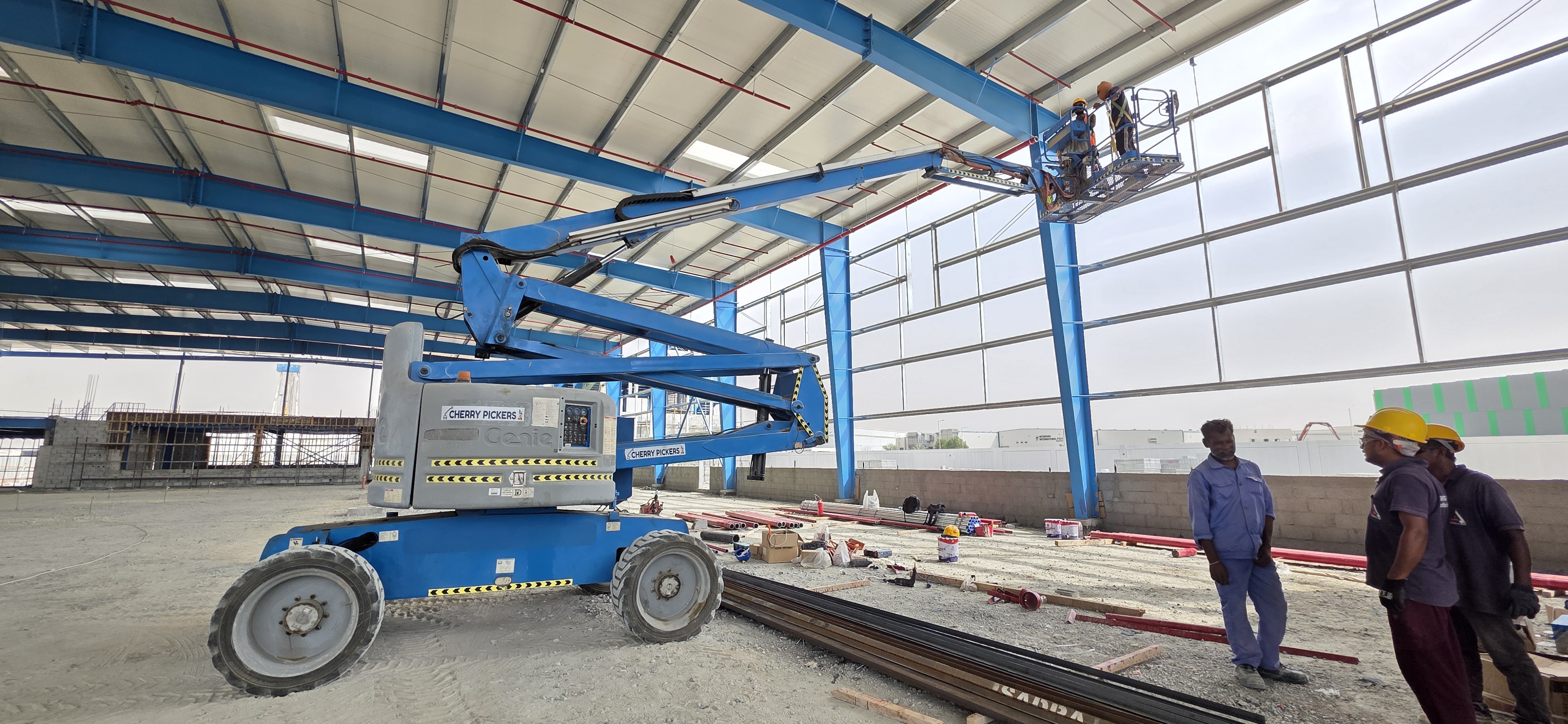
Every MEWP is engineered to operate within a set of limits, and those limits are quietly affected by temperature. Hydraulic fluid is the clearest example. In extreme heat it thins, which changes how the hydraulics respond and how much strain the system carries. Engines, batteries and cooling systems all work harder, and a machine that has not been serviced for the conditions is far more likely to overheat or develop a fault mid-task. On a diesel telescopic boom or a large articulated machine, a struggling cooling system is not just an inconvenience; it can leave a platform stranded at height.
This is why summer rewards machines with genuine maintenance behind them. A JLG boom lift, a Genie boom lift or a Haulotte unit that has been properly serviced will hold its performance in the heat far better than a neglected one, regardless of the badge. It is also why the source of a machine matters. A well-kept used JLG boom lift from a reputable rental fleet can outperform a poorly maintained newer machine when the temperature climbs, because condition, not just age, determines how a unit copes with heat. The practical takeaway for operators is simple: watch the machine as closely as the task. Sluggish hydraulic response, unusual engine temperature or a warning light is the machine telling you its margins are thinning, and the safe response is to bring the platform down and stop rather than push through to a full failure.
Wind behaves differently, and matters more
Wind is the single most important environmental factor in aerial work, and summer in the Gulf makes it less predictable. Afternoon sea breezes and shamal winds can build quickly, and the critical point that catches operators out is that wind is far stronger at height than at ground level. Wind at a 20-metre platform can be around 50% stronger than what is felt on the ground, so an operator sheltered at low level can rise straight into gusts that exceed the machine's rating without realising it.
Most outdoor-rated machines carry a maximum wind rating of 12.5 m/s (28 mph) under the EN 280 standard, and that figure appears on the machine's data plate for a reason. Above it, stability is no longer guaranteed. On a tall unit with significant horizontal reach, such as a JLG 1200SJP or JLG 1350SJP, the leverage of an extended boom in a crosswind is considerable, and the wind limit is not a suggestion. The habits that keep crews safe are unchanged in principle but more important in summer:
- Know the wind rating for the specific machine on site, and confirm it matches the actual unit, not a similar one.
- Keep an anemometer available and re-check wind speed as the platform elevates, not just at ground level.
- Lower the platform and stop work if wind or gusts reach the machine's limit.
- Never attach banners, signboards or sheet materials to the platform, as they act as sails.
An indoor-only machine, such as a slab scissor lift with non-marking tyres, has no wind rating at all and must never be taken outdoors. That distinction matters more in summer, when the temptation to move an available indoor unit outside for a quick job can be strong.
The operator is part of the safety system
A MEWP is only as safe as the person on the controls, and heat degrades human performance in ways that are easy to underestimate. UAE summer temperatures routinely exceed 45°C, and a steel platform in direct sun runs hotter still. Fatigue, headache, dizziness and slowed concentration are early signs of heat stress, and every one of them erodes the judgement and reaction time that safe operation depends on. An operator making a marginal decision about wind, positioning or ground conditions while mildly heat-affected is a genuine hazard, even if the machine itself is performing perfectly.
This reframes what a safety check covers in summer. It is no longer only the machine and the site; it is the operator's condition too. The UAE's Midday Break rule, which restricts outdoor work during the hottest afternoon hours, exists precisely because human performance collapses in extreme heat. Treating that rule as a floor rather than a target, scheduling exposed high-level work for the early morning, keeping water on the platform, rotating operators on long jobs and treating any heat-stress symptom as a reason to come down rather than push on, is part of safe operation, not an optional extra.
The working envelope shrinks
Put the machine and the operator together and the practical result is that the safe working envelope of any given job is smaller in summer than in winter. The hours available for exposed work are fewer. The wind margin is tighter because conditions shift faster. The machine's tolerance for being pushed is lower. And the operator's reserve of concentration and stamina is smaller. A job that was comfortably within limits in cooler months can sit much closer to the edge in July, even with the same machine, the same crew and the same task.
Recognising this is the core of summer safety. It is not that the work becomes impossible; it is that the same work now needs more planning, closer monitoring and a greater willingness to stop. A bi-energy boom lift that can switch to electric indoors, an electric boom lift that removes engine heat from an enclosed space, or a spider lift from a maker like Teupen that reaches a confined courtyard, each earns its place partly by keeping the operator out of the most punishing conditions. Matching the machine to the environment is itself a heat-safety decision.
What safe operation looks like in practice
Pulling it together, safe operation in UAE summer conditions means holding to the same fundamentals while accepting that the limits around them have moved. In practice that looks like:
- A machine chosen for the environment as well as the reach, so the operator is not needlessly exposed to heat or fumes.
- A pre-use inspection that treats fluids, filters and cooling as summer-critical, not routine.
- Wind checked at height and re-checked as the platform rises, with a firm limit and a willingness to lower.
- An operator who is hydrated, rotated and monitored for heat stress as carefully as the machine is monitored for faults.
- Work scheduled around the coolest hours and the Midday Break rule, with the confidence to stop when conditions or the machine say so.
- A trained, ideally IPAF-certified operator who understands that the summer envelope is smaller and plans for it.
None of these is complicated on its own. What changes in summer is that skipping any one of them costs more, because the margins that used to absorb a small mistake are no longer there.
Frequently asked questions
Does extreme heat make MEWPs unsafe to use?
Not on its own. Heat narrows the margins that safe operation relies on, affecting hydraulics, cooling and battery performance, and degrading operator concentration. A well-maintained machine, a heat-aware routine and a trained operator keep work safe, but the same job needs more planning and closer monitoring than in cooler months.
How does heat affect a boom lift's performance?
Heat thins hydraulic fluid and makes engines, batteries and cooling systems work harder, raising the risk of overheating and faults on machines that are not properly serviced. Operators should watch for sluggish hydraulic response or unusual engine temperature and lower the platform if the machine shows signs of struggling.
Why is wind more dangerous in summer aerial work?
Gulf summer winds, including sea breezes and shamal winds, can build quickly, and wind is significantly stronger at height than at ground level. Since most outdoor-rated machines are limited to 12.5 m/s (28 mph), an operator can rise into gusts that exceed the rating, so wind must be checked at height and re-checked as the platform elevates.
What is the safest way to run a MEWP in UAE summer?
Choose a machine suited to the environment, complete a heat-focused pre-use inspection, check wind at height, keep the operator hydrated and rotated, schedule exposed work around the coolest hours and the Midday Break rule, and use a trained, ideally IPAF-certified operator. Treat any sign of machine strain or operator heat stress as a reason to stop.
Why Choose Cherry Pickers Equipment
Safe summer operation depends on equipment that is fit for the conditions, and that comes down to how a supplier maintains its fleet. Cherry Pickers Equipment sources machines from reputed rental fleets with strong maintenance histories, and keeps more than 90% of the fleet in rental-ready condition, so equipment arrives inspected, certified and ready to handle heat, wind and dust. Our range spans compact electric scissor lifts and slab scissors through to tall telescopic and articulated booms, including trusted names like JLG, Genie, Haulotte, Snorkel, Nifty, Dingli and Sinoboom, so you can match both the specification and the budget. With expert guidance on specification, trained and IPAF-certified operators on request, proven expertise in global packing and worldwide delivery, and flexible financing for existing and frequent buyers, we make sourcing the right machine straightforward. Customer trust matters more to us than any single deal, which is why so much of our business comes from clients who come back.
Need access equipment ready for UAE summer conditions? Browse the Cherry Pickers Global fleet or contact our team. We'll help you specify the right machine, delivered inspected and certified, ready to work across Dubai, Sharjah and Abu Dhabi.