Wind, Heat & Sand: Operating MEWPs Safely in UAE Summer Conditions
A practical safety guide to running boom lifts and scissor lifts through the UAE summer, covering wind ratings, extreme heat, blowing sand and the checks that keep crews safe at height.
The UAE summer is one of the most demanding environments in the world to operate a mobile elevating work platform. Between June and September, crews face sustained extreme heat, sudden gusty winds, and airborne sand that most equipment elsewhere never encounters. None of it makes working at height impossible, but each factor changes how a machine behaves and how it must be operated. This guide covers what matters most, and the habits that keep operators safe when conditions turn.
Wind: the hazard that increases with height
Wind is the single most important environmental factor in MEWP operation, and it is easy to underestimate at ground level. Every outdoor-rated boom lift and scissor lift carries a maximum wind rating on its data plate and at the control position. For most outdoor-rated machines, that limit is 12.5 m/s (28 mph), the maximum design wind speed under the EN 280 standard. Above it, stability is no longer guaranteed.
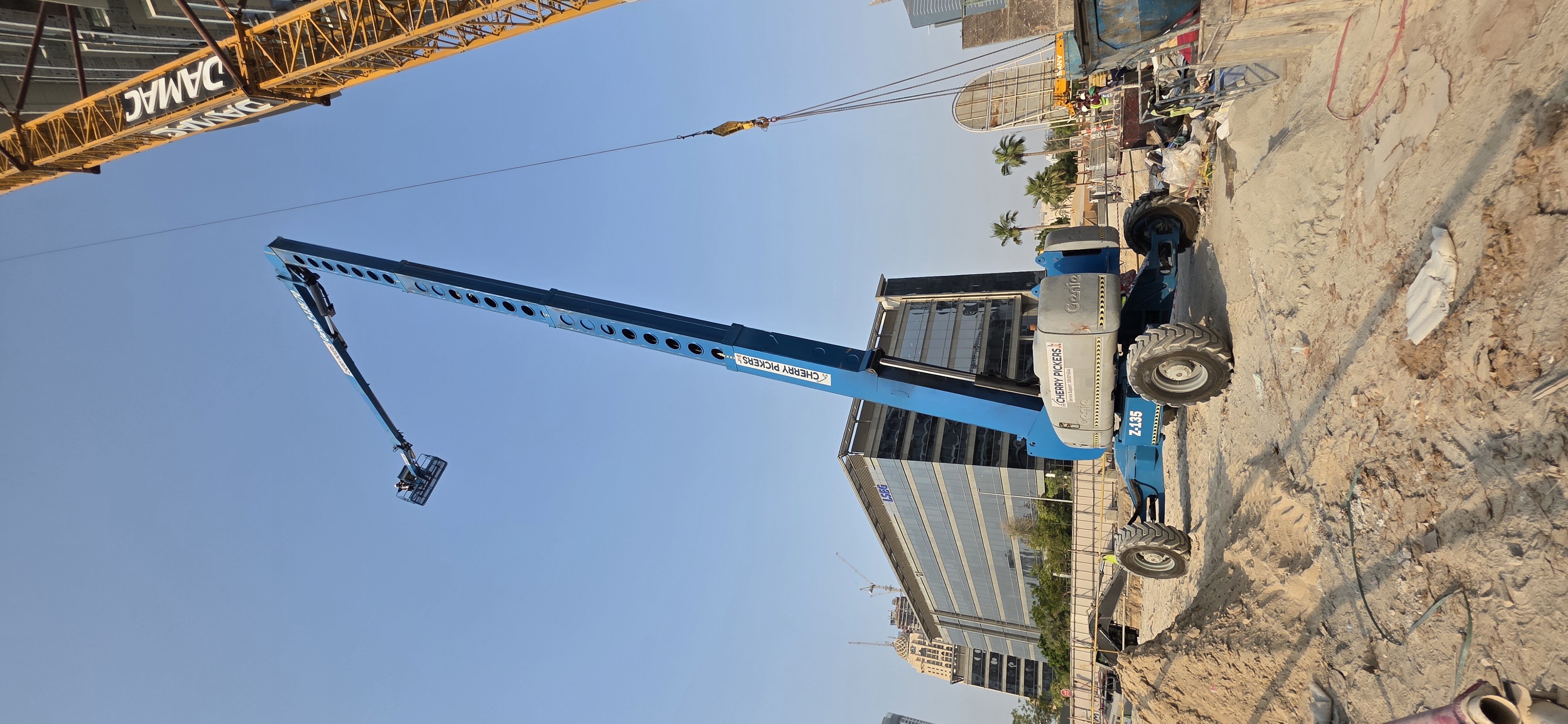
The trap is that wind speed rises sharply with elevation. Wind at a 20-metre platform height can be around 50% stronger than at ground level, and buildings can funnel gusts that were mild in the open. On a tall telescopic or articulated boom, an operator sheltered at low level can rise straight into conditions that exceed the rating. The rules that keep crews safe are simple and non-negotiable:
- Check the wind rating for the specific machine, since indoor-only units have no wind rating and must never be used outdoors.
- Use an anemometer and re-check it as the platform elevates, not just at ground level.
- If wind or gusts reach the machine's limit while raised, lower the platform and stop work until it drops.
- Never attach signboards, banners or sheet materials to the platform, as they act as sails and can destabilise the machine even in moderate wind.
Cladding panels, glass and other large flat items deserve particular care in the Gulf, where afternoon sea breezes and shamal winds can pick up quickly.
Extreme heat: protecting operators and machines
UAE summer temperatures routinely exceed 45°C, and a steel platform in direct sun runs hotter still. Heat is both a human hazard and a mechanical one. For crews, the risks are heat exhaustion and heatstroke; the UAE's Midday Break rule, which restricts outdoor work during the hottest afternoon hours in summer, exists precisely because of this. Schedule high, exposed work for early morning where possible, rotate operators, keep water on the platform, and watch for early signs of heat stress, because a worker feeling unwell at height is a serious situation.
Machines feel the heat too. Hydraulic fluid thins, engines and batteries run hotter, and cooling systems work harder. This is where a properly serviced fleet pays off: overheating and hydraulic faults are far more likely on machines that have not been maintained for the conditions. Cherry Pickers Global sources equipment from reputed rental fleets with strong maintenance histories, and keeps more than 90% of the fleet in rental-ready condition so machines arrive fit for the environment they will work in. For enclosed indoor sites where fumes and heat compound, electric boom lifts and scissor lifts remove engine heat and emissions from the equation entirely.
Sand and dust: the Gulf-specific factor
Blowing sand is the condition operators outside the region rarely plan for. It reduces visibility, works into moving parts, clogs filters and coats control panels and sensors. During a sandstorm, the same rule as high wind applies: if visibility or wind makes safe operation impossible, the platform comes down. Beyond the storms, fine dust is a constant, which is why daily pre-use checks matter more here than almost anywhere else:
- Clean and inspect controls, sensors and safety decals before each shift.
- Check filters and cooling intakes for dust build-up.
- Confirm the machine's inspection and certification are current, and never assume.
Operator competence and certification
None of the above protects a crew if the operator is not properly trained. IPAF certification is increasingly expected by larger clients and contractors across the UAE, even where it is not strictly mandated, and it is the clearest evidence that an operator understands wind ratings, ground conditions, rescue procedures and safe platform use. Dubai Municipality's technical guidelines for MEWPs also require toolbox talks and task-specific risk assessments before work begins, and both are worth treating as standard practice, not paperwork.
Where a client needs it, Cherry Pickers Global can support operations with trained, IPAF-certified operators, so safe and efficient use is built in rather than assumed.
A summer pre-work checklist
- Confirm the machine's wind rating and have an anemometer on site.
- Check the forecast for wind, gusts and sand, and re-assess through the day.
- Plan exposed work around the coolest hours and the Midday Break rule.
- Complete daily pre-use inspection: controls, filters, fluids, decals, emergency lowering.
- Verify inspection and certification are current on the machine.
- Ensure the operator is trained and, ideally, IPAF-certified.
- Match the machine to the site: electric indoors, rough-terrain for unprepared ground, and the right reach for the task.
Frequently asked questions
What wind speed is too high to operate a MEWP?
Most outdoor-rated boom lifts and scissor lifts have a maximum wind rating of 12.5 m/s (28 mph). Above that, or if the machine's own data plate specifies a lower limit, operation is unsafe. Remember that wind is stronger at height than at ground level.
Can boom lifts operate in UAE summer heat?
Yes, provided the machine is well maintained and crews follow heat-safety practices such as scheduling around the Midday Break rule, rotating operators, staying hydrated, and watching for heat stress. A properly serviced fleet greatly reduces the risk of heat-related mechanical faults.
Should work stop during a sandstorm?
If blowing sand reduces visibility or is accompanied by high winds that make safe operation impossible, the platform should be lowered and work paused until conditions improve. Daily cleaning and inspection of controls and filters is essential in dusty conditions.
Is IPAF certification required to operate a MEWP in the UAE?
IPAF certification is increasingly expected by larger UAE clients and contractors even where not strictly mandated. It demonstrates an operator understands safe operation, wind ratings and rescue procedures. Cherry Pickers Global can provide IPAF-certified operators on request.
Why Choose Cherry Pickers Equipment
Operating safely in UAE summer conditions starts with equipment that is fit for the environment, and that comes down to how a supplier maintains its fleet. Cherry Pickers Equipment sources machines from reputed rental fleets with strong maintenance histories, and keeps more than 90% of the fleet in rental-ready condition, so equipment arrives inspected, certified and ready to handle heat, wind and dust. Our team offers expert guidance on specifying the right machine for the site, provides trained and IPAF-certified operators on request, and backs it all with flexible arrangements built around how you actually work. Customer trust matters more to us than any single hire, which is why so much of our business comes from clients who come back.
Need reliable access equipment built for UAE summer conditions? Browse the Cherry Pickers Global fleet or contact our team. We'll help you specify the right machine, delivered inspected and certified, ready to work across Dubai, Sharjah and Abu Dhabi.