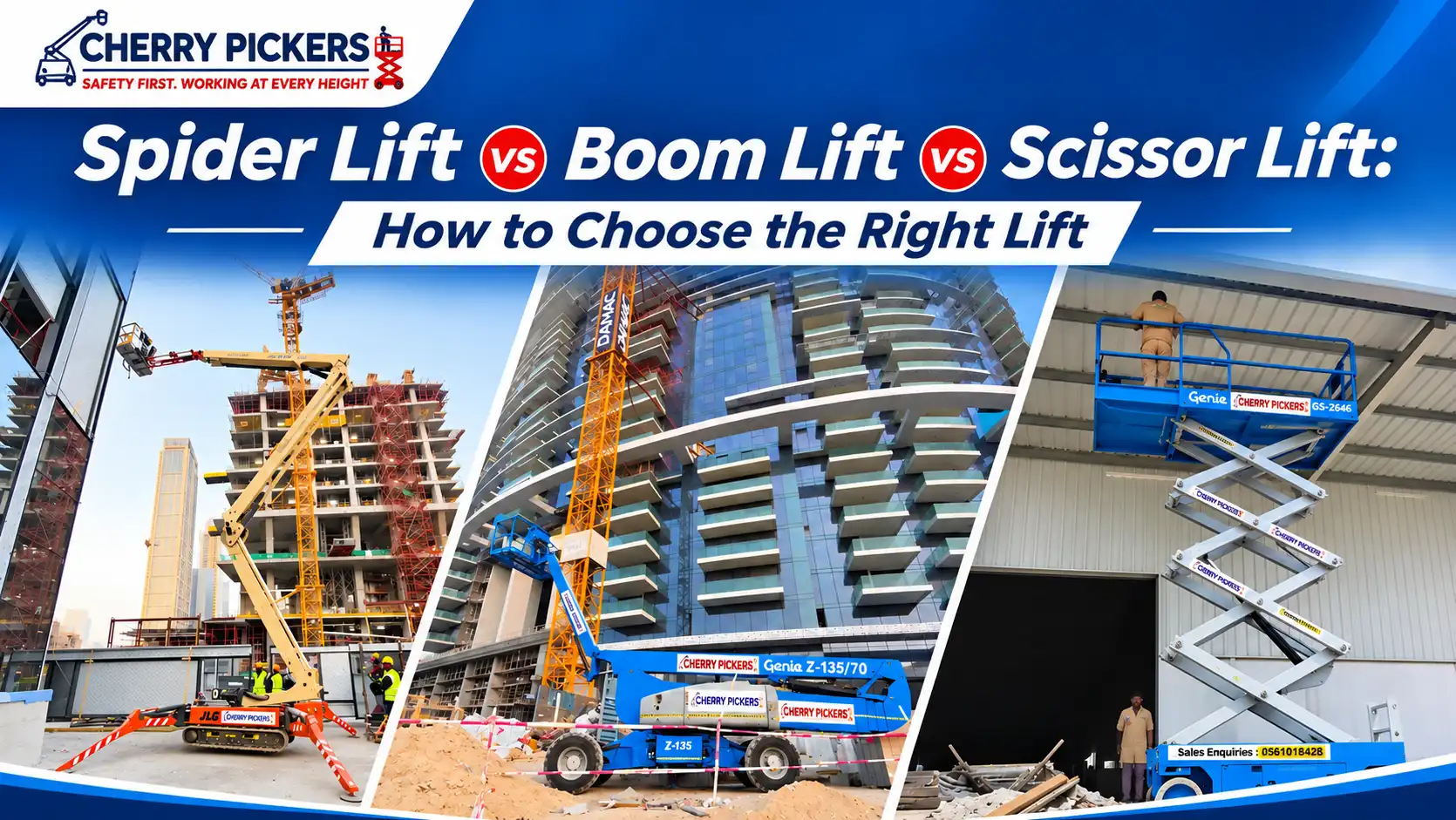
Spider Lift vs Boom Lift vs Scissor Lift: How to Choose the Right Lift
Choosing the right access equipment is important for completing work-at-height tasks safely and efficiently. Whether you are working on a construction site, maintaining an industrial facility or carrying out building repairs, the equipment you choose should match your working height, site conditions and access requirements.
Spider lifts, boom lifts and scissor lifts are commonly used types of Mobile Elevating Work Platforms (MEWPs). Although all three provide access to elevated work areas, they differ in design, movement, reach and applications.
For contractors looking for Access Equipment Rental UAE, understanding these differences makes it easier to choose the right lift for each project.
What Is a Spider Lift?
A spider lift is a compact aerial work platform designed for working in restricted and difficult-to-access locations. It typically features a tracked undercarriage, an extendable boom and stabilising outriggers that provide support during operation.
Its compact design allows suitable models to pass through narrow entrances and access areas where larger machines may not fit.
Common applications include:
- Indoor building and ceiling maintenance.
- Industrial facility inspections.
- Tree maintenance and pruning.
- Building restoration work.
- Maintenance in restricted-access areas.
Spider lifts are particularly useful when a project requires elevated access but has limited space for positioning conventional equipment.
What Is a Boom Lift?
A boom lift is an aerial work platform that uses an extendable arm to position workers at different heights and distances. Unlike a standard scissor lift, it provides both vertical height and horizontal outreach.
There are two main types of boom lifts:
1. Articulated Boom Lifts
Articulated boom lifts have multiple boom sections connected by joints. This design allows the platform to move up, over and around obstacles, making them suitable for accessing areas behind structures, pipes and other obstructions.
2. Telescopic Boom Lifts
Telescopic boom lifts have straight, extendable boom sections that provide greater horizontal outreach. They are commonly used on construction sites and in large industrial environments where workers need to reach elevated areas across open spaces.
Common applications of boom lifts include:
- Building facade maintenance
- Construction and structural work
- Industrial equipment inspection
- Elevated installation activities
- Painting and maintenance of structures
Boom lifts are a practical choice when workers need to reach elevated work areas that are not directly above the machine.
What Is a Scissor Lift?
A scissor lift is a vertical lifting platform that uses a folding criss-cross mechanism to raise workers to the required height.
Unlike boom lifts and spider lifts, scissor lifts provide mainly vertical access. Some models feature an extendable platform deck that provides additional reach. Their spacious platforms make them suitable for jobs involving multiple workers, tools and materials.
The two common types are:
1. Electric Scissor Lifts
Electric scissor lifts are mainly designed for indoor applications such as warehouse maintenance, lighting installation and electrical work. Many models feature non-marking tyres and quiet electric operation.
2. Rough Terrain Scissor Lifts
Rough terrain scissor lifts are designed for outdoor construction and industrial sites with uneven ground. Depending on the model, they may feature larger tyres, four-wheel drive and increased ground clearance.
Common applications of scissor lifts include:
- Warehouse maintenance
- Electrical and lighting installation
- Construction activities
- Ceiling repairs
- Industrial facility maintenance
Scissor lifts are suitable when workers need straight vertical access and a spacious working platform.
Spider Lift vs Boom Lift vs Scissor Lift: Key Differences
Understanding the differences between these machines helps contractors select suitable equipment based on their project requirements.
| Feature | Spider Lift | Boom Lift | Scissor Lift |
|---|---|---|---|
| Design | Compact boom with outriggers | Articulated or telescopic boom | Vertical scissor mechanism |
| Movement | Often tracked | Usually wheeled | Usually wheeled |
| Access | Vertical and horizontal | Vertical and horizontal | Primarily vertical |
| Horizontal Reach | Available | Available | Limited extension deck |
| Stabilisation | Outriggers | Depends on machine type | Usually not required |
| Main Advantage | Restricted-access capability | Greater outreach | Spacious working platform |
| Typical Use | Indoor and restricted-access work | Construction and industrial maintenance | Warehouse and installation work |
Specifications and operating capabilities vary depending on the manufacturer and model.
When to Choose a Spider Lift, Boom Lift or Scissor Lift
The right equipment depends on your working environment, access requirements and the type of job you need to complete.
Choose a Spider Lift for Restricted Access
A spider lift is a suitable option when your working area has narrow entrances, limited positioning space or access restrictions.
For example, maintenance teams working inside commercial buildings may need to reach high ceilings through narrow doorways. A suitable compact spider lift can provide access where larger boom lifts cannot enter.
Choose a Boom Lift for Greater Horizontal Reach
A boom lift is suitable when workers need to reach elevated locations positioned away from the machine.
For example, construction teams carrying out external building maintenance may need to access different sections of a structure without positioning the machine directly underneath the work area.
An articulated boom lift is useful for reaching around obstacles, while a telescopic boom lift is suitable when greater horizontal outreach is required.
Choose a Scissor Lift for Vertical Access
A scissor lift is generally the preferred option when the work area is directly above the machine and a larger working platform is required.
For example, warehouse teams installing lighting fixtures or maintaining overhead electrical systems can use suitable electric scissor lifts for straight vertical access.
Factors to Consider Before Renting Access Equipment
Before arranging spider lift, boom lift or scissor lift rental, consider the following factors to choose suitable equipment for your project.
1. Working Height: Identify how high you need to reach. Check both platform height and working height when comparing different machines.
2. Horizontal Outreach: Consider how far the platform needs to extend to reach your work area. Boom lifts and suitable spider lifts can provide horizontal outreach.
3. Site Access: Check entrance width, machine dimensions, turning space and overhead clearance. This is especially important for projects with narrow entrances or restricted access.
4. Ground Conditions: Check floor loading limits, slopes, uneven surfaces and ground strength. Spider lift outriggers need suitable supporting surfaces to operate safely.
5. Platform Capacity: Check the combined weight of workers, tools and materials. Never exceed the machine's rated platform capacity.
6. Power Source: Choose electric or engine-powered equipment according to your application, ventilation requirements and site restrictions.
Benefits of Renting Spider Lifts, Boom Lifts and Scissor Lifts
Purchasing access equipment may not be practical for contractors who need different machines for individual projects. Renting equipment provides flexibility to select suitable machines according to the job.
Some key benefits include:
- Flexible Rental Periods: Arrange equipment for short-term or long-term projects, subject to availability.
- Reduced Capital Investment: Avoid the upfront cost of purchasing specialised equipment.
- Equipment Selection: Choose different access platforms based on working height and site conditions.
- Technical Support: Access maintenance and technical assistance according to the agreed rental arrangement.
- Project Flexibility: Select different machines as your project requirements change.
Choose the Right Access Equipment with Cherry Pickers
Spider lifts, boom lifts and scissor lifts each serve different work-at-height requirements. Spider lifts are useful for restricted-access locations, boom lifts provide greater horizontal outreach, and scissor lifts offer practical vertical access with spacious working platforms.
At Cherry Pickers Equipment Rentals, we provide access equipment rental solutions, including articulated boom lifts, telescopic boom lifts, electric scissor lifts, rough terrain scissor lifts and spider lifts.
Not sure which access platform is right for your project? Contact our team to find suitable equipment based on your required working height, site conditions and rental duration.
Call: +971 56 101 8428
Website: https://cherrypickersglobal.com/
Frequently Asked Questions
1. What is the main difference between spider lifts, boom lifts and scissor lifts?
Spider lifts are compact boom platforms with stabilising outriggers, suitable for restricted-access areas. Boom lifts provide vertical and horizontal outreach, while scissor lifts are designed mainly for vertical access with a spacious working platform.
2. Is a spider lift better than a boom lift?
A spider lift is suitable for narrow entrances, restricted-access locations and certain uneven-ground applications where the outriggers can be safely supported. A conventional boom lift is generally more suitable for larger work areas requiring greater outreach. The right choice depends on your project requirements.
3. Can spider lifts be used indoors?
Yes. Suitable spider lifts can be used for indoor ceiling maintenance, building inspections and elevated installation work. However, floor loading capacity, entrance dimensions and outrigger requirements must be checked before use.
4. Which lift is best for warehouse maintenance?
Electric scissor lifts are commonly preferred for warehouse maintenance, lighting installation and ceiling repairs because they provide vertical access and a spacious working platform. A boom lift may be more suitable when horizontal outreach is required.
5. What should I consider before renting access equipment?
Consider working height, horizontal outreach, platform capacity, ground conditions, entrance dimensions, power source and rental duration. These factors help you choose the right spider lift, boom lift or scissor lift for your project.